Travel Manitoba marketing brings a $23 to $1 return on investment
Our marketing delivers results for the province, according to Tourism Economics' analysis of Travel Manitoba’s 2025 marketing activities We attract over half a million visitors supporting local businesses and generating $180 million in direct spending with our marketing and for every dollar invested, $4 of tax revenue returns to benefit communities across the province.
We shared the results of the Tourism Economics report at our November 3 at the Annual General Meeting.
A return that reaches communities across Manitoba
Manitoba's tourism industry is a powerful economic driver for the province. In 2025, the province welcomed nearly 11.1 million visitors who spent almost $2.4 billion. That's a record year for visitor spending.
In this latest report specifically focusing on Travel Manitoba’s marketing initiatives, we are directly responsible for generating $180 million in visitor spending. That is more than a twentyfold return on investment that supports Manitoba's small businesses like local restaurants, hotels and accommodations, attractions, events and conferences, local retailers and transportation between our destinations. With the additional $97 million in indirect and induced sales generated through our marketing efforts, that total economic impact bumps up to $277 million.
Tourism: a tariff-free export that benefits all Manitobans
We also shared that for every dollar spent on our marketing, $4 goes to government tax revenue to keep Manitobans healthy, active and engaged in our communities in all four corners of our province.
Tourism brings economic activity directly into Manitoba communities. Visitors spend money on local experiences, accommodation, dining, transportation and shopping, supporting businesses and workers throughout the province.
From the Statistics Canada 2025 results, we know that visitation to Manitoba from across Canada has risen 15 per cent, with visitor spending increasing more than 28 per cent. U.S. visitation grew by 50 per cent in 2025, with spending up an astonishing 194 per cent. So while U.S. visitors represented 4 per cent of total visitors to Manitoba, their spending represented 15 per cent of all visitor spending. International visitation was also up 52 per cent, with international visitor spending up 53 per cent.
These are incredible results. However, we want to note that international results are partially a correction on previous underreporting. Still, Manitoba was one of a handful of provinces that saw U.S. visitation climb in 2025 – overall U.S. visitation to Canada was down 3 per cent.
Tourism is more than an opportunity to showcase Manitoba to the world. It is an export industry that brings new dollars into the province when visitors travel here and spend money.
Turning marketing investment into economic impact
Travel Manitoba’s results highlight the value of strategic tourism marketing in a competitive destination marketplace. By raising awareness of Manitoba as a destination, inspiring travel and connecting potential visitors with experiences across the province, our marketing helps convert a search into a booked trip, an extra overnight stay and memories created over shared experiences that last a lifetime.
With record visitor spending and a strong return on marketing investment, Manitoba’s tourism industry continues to demonstrate its value as an economic driver, creating jobs, tax revenues and benefits for all Manitobans.
Our $23 return on investment through our tourism marketing creates tangible results that support Manitoba businesses, communities and experiences that showcase how Canada's Heart is Calling.
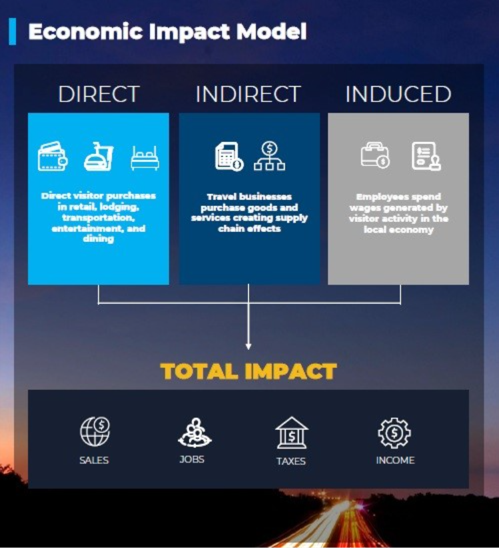
Economic Impact Model
The development of visitor economy impact modeling begins with a comprehensive demand side analysis. Visitor survey data provides estimates on the volume of visitors by type and their spending in specific industries (e.g., lodging, restaurants, retail, recreation and entertainment, transportation).
These estimates are strengthened through an analysis of industry-specific data sets on the lodging industry, aviation and sectoral-level business sales.
Government data, including taxes by type, as well as employment and personal income by industry, are used to supplement and confirm demand-side visitor spending calculations. This provides a detailed profile of visitor spending by industry, which is then connected to a local input-output (I-O) economic impact model constructed within the IMPLAN platform. This uses government (Statistics Canada) data to trace the flow of visitor spending through the local economy and its effects on businesses, households and government. The model quantifies three levels of impact:
- Direct impacts: Visitor spending creates direct economic value within a defined set of sectors. This supports a proportion of spending, jobs, wages, and taxes within each sector.
- Indirect impacts: Businesses providing direct services to visitors purchase goods and services, generating additional impacts called indirect impacts or supply-chain effects.
- Induced impacts: Additional business activity is generated as employees spend incomes locally that are earned due to visitor activity. This is called the induced impact or income effect.